
Publications
THE WALL STREET JOURNAL

Attached to Accuracy
Tonight's bout of vigilante fact-checking was prompted by a story on the web site of Attachment Parenting International (API). API is a nonprofit that advocates for what is these days the ascendant philosophy of child-rearing. Best known through the works of William...

On Civic Minded: Jane Jacobs drew the map on online community
From my Civic Minded blog on Corante:
Today marked the end of Jane Jacobs' life, but not of her work. Jacobs' pioneering work in urban planning changed the way we think about cities — and by redefining our ideas about how cities work as communities, she set the stage for the best thinking about online community today….
Jacobs' death reminds me how much my own work in online community, and the work of Internet community-builders in general, owes to that earlier generation who reclaimed urban centres as living communities. The most important principles of online community building and online dialogue grow out of the experiences of urban community planners and participation planners: Communities are about people, not structures. Healthy communities are owned and shaped by their members, not by some team of expert planners. Communities thrive on activity and diversity. And if many of the most influential experiments in online community are those that tie online communities to real-world towns and cities — projects like Die Digitale Stadt, MeetUp or even craigslist — they also owe a debt to Jacobs for helping to keep those real-world communities vital.

Online community camp, May 25th in San Francisco
Forum One is hosting a one-day Online Community Camp in San Francisco on May 25th. According to the preliminary schedule, planned topics include:
* Community management issues;
* Online community business models and ROI; * Online community marketing;
* Online community performance metrics;
* Review of community tools;
* Tactics for smoothly changing community platforms;
* Online communities and advertising;
* Technical standards to allow communities to share members;
* Effective use of volunteers;
* Reputation and ranking strategies
* Legal issues
* Using online communities to enhance interaction within physical communities like neighborhoods, towns, and cities.
While registration is almost full, there are some spaces yet (and some scholarships still available), so if you're interested contact Jim Cashel asap.

Ode to Aggregator2 on WorldChanging
I have a piece on WorldChanging today about using Drupal's Aggregator2 module as a news tracking tool. The piece was partly inspired by a recent inquiry about why to use Aggregator2 rather than Drupal's default:
Aggregator2 turns the Drupal platform into a powerful tool for news tracking and republishing by offering options for customizing news feeds, tagging news items, and moderating incoming news. That feature set makes Aggregator2 an exceptionally flexible choice for setting up a nonprofit news tracker that aggregates news from a wide range of blogs, news sites and search engines. Because Aggregator2 saves each individual item as an independent node (like a web page) in Drupal, you can edit or annotate news items after you bring them onto your site. Because Aggregator2 lets you assign different tags to different incoming feeds, you can set up different news pages for different topics, and direct news to show up on the appropriate pages. And Aggregator2 is also a terrific tool for integrating content from multiple related web sites or overlapping organizations.

Social Tech Brewing Vancouver: May 4 at the Whip
If you work at the intersection of technology and community-building, we hope you'll join us for a May 4th gathering of Social Tech Brewing's Vancouver chapter. Social Tech Brewing brings together folks from nonprofit organizations, community service, social activism, social ventures and technology to share ideas — and beer!
Our May 4th event will look forward to the June meeting of the UN's World Urban Forum (WUF) here in Vancouver. WUF will bring a remarkable range of government leaders, community development workers and urban activists to Vancouver to talk about the future of sustainable cities. And the lead-up to WUF has already featured one of the Net's most ambitious online dialogue efforts to date, the Habitat Jam.
The STB meeting on May 4th will feature a short panel and Q&A session to illuminate some of the innovative technology projects that are happneing around the WUF meeting. We'll hear from one of the members of the Habitat Jam team about what was learned from the Jam experiment. And we'll also hear from Steven Forth of the Global Urban Sustainable Solutions Exchange, a Vancouver-based information and social networking resource that will launch at the WUF in June.
The panel will start at 6:15 and wrap by 6:45, so please come early so you can be part of the discussion. And plan to stick around for another hour after the panel to be part of the beer drinking, gossip exchange, and general consipracy-hatching.
We hope to see you there! Please RSVP on Upcoming.org
Event details
Social Tech Brewing Vancouver
Thurday, May 4th
6pm-8pm
at
The Whip (map)
209 6th Avenue East (at Main), Vancouver
Any questions? Email info@socialsignal.com

New from NetSquared: Net2Learn
Today we're launching a new feature on NetSquared: Net2Learn. Net2Learn (http://learn.netsquared.org) is a collection of resource centers on topics that matter to nonprofits: topics like Online P.R. for nonprofits, Managing an online community forum, and 10 tools you need now. Best of all, Net2Learn makes it easy for you to contribute your favorite web links, resources and examples to each resource center — or to create a new resource center yourself.

From Corante: snail mail as a digital campaign tool
From my blog on Corante: Anti-war e-activists have embraced one of the old standbys of pre-digital politics: snail mail. Bring Them Home Now is selling postage stamps with the "bring them home" symbol: a yellow ribbon super-imposed on a peace sign. BTHN is encouraging...

RSS, tags & social bookmarking: building blocks for nonprofit collaboration
I'm currently at NTen's Nonprofit Technology Conference in Seattle, where I was part of a panel yesterday on "Blogging, Tagging, Flickring for the cause: New tools and new strategies." Along with Victor d'Allant of Social Edge and Ruby Sinreich, I gave a kind of crash...

Business tunes into grassroots community
I’m just back from SXSW, where I was reminded that there are still a few people out there who are thinking about the Internet as a potential business opportunity rather than as a chance to reinvent democracy.
At the panel I was on — Remixing Business for a Convergent World — it seemed that what is really converging is how both business folks and political hacks are looking at the Net. Let’s take, for example, the question of how to make strategic use of blogs — a question that my fellow-panelist, Robert Scoble, addresses in his recent book Naked Conversations.
Thanks to blogs, businesses can no longer afford to ignore even their smallest customers. Traditional blue-chips are starting to recognize that their next p.r. crisis could be precipitated by a cranky shareholder or dissatisfied customer who blogs about the company. As for the latest generation of web start-ups — sites like Squidoo, Frappr, or LinkedIn — they’re not only sensitive to customer perceptions: their entire business models are based on user (i.e. customer) contributed value.
Once you start to see customers are value creators, rather than value consumers, a lot of business truths get turned upside-down. Take, for example, the idea that businesses are primarily accountable to their boards or shareholders. Does anyone out there think that the success of del.icio.us or Flickr depends more on Yahoo shareholders than on the users who are contributing bookmarks, photos, and software plug-ins?
If businesses find themselves suddenly accountable to their users, that kind of accountability is old news to both government and civil society organizations. Governments have always been primarily (if imperfectly) accountable to citizen-voters, and civil society organizations (whether community service groups or political advocacy organizations) have always been primarily accountable to their members and donors.
The net result is that it’s business that now needs to learn from civic and public organizations about how to enage at the grassroots level. It’s not like public and nonprofit organizations have all the answers — great examples of effective two-way member/voter engagement online are still rarer than the many examples of organizations that are still in “broadcast” mode — but at least there’s a decade of effort to look at.
For those of us who’ve been thinking about online democracy and grassroots engagement for something like that long, the rise in business interest should come as (mostly) good news. Sure, there’s more competition for public attention: efforts at getting voters to participate in policy discussion now have to compete with businesses offering free ipods in return for customer feedback.
But there’s also a rapidly expanding toolkit for grassroots community-building. Tools like Squidoo, Flickr, and del.icio.us offer entirely new ways of involving members and encouraging members to interact with one another. Just as important, the private sector’s growing embrace of customer “community” may help to build a broader culture of pervasive engagement.

Monkey Love
Monkey love Last night someone handed me this monkey at the Flickr/Yahoo/del.icio.us party,and told me I was supposed to pass it along. I confessed that I really wanted to just pass it along to my 2-year-old, and whoever it was who handed it to me thought that sounded...
The Harvard Business Review
Attached to Accuracy
Tonight's bout of vigilante fact-checking was prompted by a story on the web site of Attachment Parenting International (API). API is a nonprofit that advocates for what is these days the ascendant philosophy of child-rearing. Best known through the works of William...
On Civic Minded: Jane Jacobs drew the map on online community
From my Civic Minded blog on Corante:
Today marked the end of Jane Jacobs' life, but not of her work. Jacobs' pioneering work in urban planning changed the way we think about cities — and by redefining our ideas about how cities work as communities, she set the stage for the best thinking about online community today….
Jacobs' death reminds me how much my own work in online community, and the work of Internet community-builders in general, owes to that earlier generation who reclaimed urban centres as living communities. The most important principles of online community building and online dialogue grow out of the experiences of urban community planners and participation planners: Communities are about people, not structures. Healthy communities are owned and shaped by their members, not by some team of expert planners. Communities thrive on activity and diversity. And if many of the most influential experiments in online community are those that tie online communities to real-world towns and cities — projects like Die Digitale Stadt, MeetUp or even craigslist — they also owe a debt to Jacobs for helping to keep those real-world communities vital.
Online community camp, May 25th in San Francisco
Forum One is hosting a one-day Online Community Camp in San Francisco on May 25th. According to the preliminary schedule, planned topics include:
* Community management issues;
* Online community business models and ROI; * Online community marketing;
* Online community performance metrics;
* Review of community tools;
* Tactics for smoothly changing community platforms;
* Online communities and advertising;
* Technical standards to allow communities to share members;
* Effective use of volunteers;
* Reputation and ranking strategies
* Legal issues
* Using online communities to enhance interaction within physical communities like neighborhoods, towns, and cities.
While registration is almost full, there are some spaces yet (and some scholarships still available), so if you're interested contact Jim Cashel asap.
Ode to Aggregator2 on WorldChanging
I have a piece on WorldChanging today about using Drupal's Aggregator2 module as a news tracking tool. The piece was partly inspired by a recent inquiry about why to use Aggregator2 rather than Drupal's default:
Aggregator2 turns the Drupal platform into a powerful tool for news tracking and republishing by offering options for customizing news feeds, tagging news items, and moderating incoming news. That feature set makes Aggregator2 an exceptionally flexible choice for setting up a nonprofit news tracker that aggregates news from a wide range of blogs, news sites and search engines. Because Aggregator2 saves each individual item as an independent node (like a web page) in Drupal, you can edit or annotate news items after you bring them onto your site. Because Aggregator2 lets you assign different tags to different incoming feeds, you can set up different news pages for different topics, and direct news to show up on the appropriate pages. And Aggregator2 is also a terrific tool for integrating content from multiple related web sites or overlapping organizations.
Social Tech Brewing Vancouver: May 4 at the Whip
If you work at the intersection of technology and community-building, we hope you'll join us for a May 4th gathering of Social Tech Brewing's Vancouver chapter. Social Tech Brewing brings together folks from nonprofit organizations, community service, social activism, social ventures and technology to share ideas — and beer!
Our May 4th event will look forward to the June meeting of the UN's World Urban Forum (WUF) here in Vancouver. WUF will bring a remarkable range of government leaders, community development workers and urban activists to Vancouver to talk about the future of sustainable cities. And the lead-up to WUF has already featured one of the Net's most ambitious online dialogue efforts to date, the Habitat Jam.
The STB meeting on May 4th will feature a short panel and Q&A session to illuminate some of the innovative technology projects that are happneing around the WUF meeting. We'll hear from one of the members of the Habitat Jam team about what was learned from the Jam experiment. And we'll also hear from Steven Forth of the Global Urban Sustainable Solutions Exchange, a Vancouver-based information and social networking resource that will launch at the WUF in June.
The panel will start at 6:15 and wrap by 6:45, so please come early so you can be part of the discussion. And plan to stick around for another hour after the panel to be part of the beer drinking, gossip exchange, and general consipracy-hatching.
We hope to see you there! Please RSVP on Upcoming.org
Event details
Social Tech Brewing Vancouver
Thurday, May 4th
6pm-8pm
at
The Whip (map)
209 6th Avenue East (at Main), Vancouver
Any questions? Email info@socialsignal.com
New from NetSquared: Net2Learn
Today we're launching a new feature on NetSquared: Net2Learn. Net2Learn (http://learn.netsquared.org) is a collection of resource centers on topics that matter to nonprofits: topics like Online P.R. for nonprofits, Managing an online community forum, and 10 tools you need now. Best of all, Net2Learn makes it easy for you to contribute your favorite web links, resources and examples to each resource center — or to create a new resource center yourself.
From Corante: snail mail as a digital campaign tool
From my blog on Corante: Anti-war e-activists have embraced one of the old standbys of pre-digital politics: snail mail. Bring Them Home Now is selling postage stamps with the "bring them home" symbol: a yellow ribbon super-imposed on a peace sign. BTHN is encouraging...
RSS, tags & social bookmarking: building blocks for nonprofit collaboration
I'm currently at NTen's Nonprofit Technology Conference in Seattle, where I was part of a panel yesterday on "Blogging, Tagging, Flickring for the cause: New tools and new strategies." Along with Victor d'Allant of Social Edge and Ruby Sinreich, I gave a kind of crash...
Business tunes into grassroots community
I’m just back from SXSW, where I was reminded that there are still a few people out there who are thinking about the Internet as a potential business opportunity rather than as a chance to reinvent democracy.
At the panel I was on — Remixing Business for a Convergent World — it seemed that what is really converging is how both business folks and political hacks are looking at the Net. Let’s take, for example, the question of how to make strategic use of blogs — a question that my fellow-panelist, Robert Scoble, addresses in his recent book Naked Conversations.
Thanks to blogs, businesses can no longer afford to ignore even their smallest customers. Traditional blue-chips are starting to recognize that their next p.r. crisis could be precipitated by a cranky shareholder or dissatisfied customer who blogs about the company. As for the latest generation of web start-ups — sites like Squidoo, Frappr, or LinkedIn — they’re not only sensitive to customer perceptions: their entire business models are based on user (i.e. customer) contributed value.
Once you start to see customers are value creators, rather than value consumers, a lot of business truths get turned upside-down. Take, for example, the idea that businesses are primarily accountable to their boards or shareholders. Does anyone out there think that the success of del.icio.us or Flickr depends more on Yahoo shareholders than on the users who are contributing bookmarks, photos, and software plug-ins?
If businesses find themselves suddenly accountable to their users, that kind of accountability is old news to both government and civil society organizations. Governments have always been primarily (if imperfectly) accountable to citizen-voters, and civil society organizations (whether community service groups or political advocacy organizations) have always been primarily accountable to their members and donors.
The net result is that it’s business that now needs to learn from civic and public organizations about how to enage at the grassroots level. It’s not like public and nonprofit organizations have all the answers — great examples of effective two-way member/voter engagement online are still rarer than the many examples of organizations that are still in “broadcast” mode — but at least there’s a decade of effort to look at.
For those of us who’ve been thinking about online democracy and grassroots engagement for something like that long, the rise in business interest should come as (mostly) good news. Sure, there’s more competition for public attention: efforts at getting voters to participate in policy discussion now have to compete with businesses offering free ipods in return for customer feedback.
But there’s also a rapidly expanding toolkit for grassroots community-building. Tools like Squidoo, Flickr, and del.icio.us offer entirely new ways of involving members and encouraging members to interact with one another. Just as important, the private sector’s growing embrace of customer “community” may help to build a broader culture of pervasive engagement.
Monkey Love
Monkey love Last night someone handed me this monkey at the Flickr/Yahoo/del.icio.us party,and told me I was supposed to pass it along. I confessed that I really wanted to just pass it along to my 2-year-old, and whoever it was who handed it to me thought that sounded...
OneZero

10 action recommendations based on Industry Canada’s Digital Economy conference
Today’s Digital Economy conference has surfaced the hunger for a serious effort at moving Canada back into a leadership position in the global digital economy. As the day has unfolded, many people have noted that we need to meet that hunger with a concrete action plan. Here’s my first crack at a set of recommendations, guided by our experience in the emergent field of social media, for both action and further dialogue.

Social media questions for Industry Canada’s conference on Canada’s Digital Economy
I’m at a Canadian Government’s conference in Ottawa today on “Canada’s Digital Economy: Moving Forward“. Since the conference seems to consist largely of folks from the “traditional” tech world, I’m curious to see how the panelists and audience engage with the question of how social media changes the challenges and opportunities for Canadian IT.

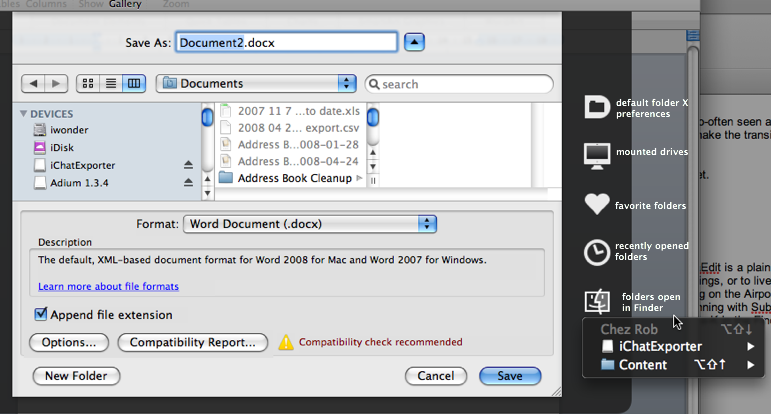
6 ways to customize your Mac’s Finder and user experience
Happily, it’s easier to tweak your Mac than to upgrade your boyfriend or girlfriend. Here are some adjustments that any new Mac user should undertake, or at least consider, until your computer is exactly right for you.
![Tony nominee [title of show] is a case study in social media creativity](https://www.alexandrasamuel.com/wp-content/uploads/2011/10/20090607-kqdh8auxx64w1q9ix4cx9fr3dr-1.png)
Tony nominee [title of show] is a case study in social media creativity
If you want to tap the expressive and marketing power of social media, you can learn a lot from the Tony-nominated [title of show].
12 questions for meaningful online conversations
My recent blog post for Harvard Business Online looks at how companies can best engage the Trojan Horse of social media, and it’s drawn some insightful comments.
4 Mac applications that make you more productive
Here are four Mac-only apps that will warm the heart of anyone who’s made the jump from Windows — and thrill long-time Mac users, too.
18 tools for effective social media participation on blogs and beyond
An overview of the tools I rely on to participate effectively in the thriving world of social media.

5 ways to protect your Mac’s looks and performance
Like any passionate affair, your romance with a new Mac can fizzle when you discover the limitations of your beloved. Your new Mac is much less likely to drive you crazy than that old machine running Windows Vista, but it’s not without the occasional quirk. Here are five highly recommended investments that will help protect you from software frustrations or hardware failures.
JSTOR DAILY
10 action recommendations based on Industry Canada’s Digital Economy conference
Today’s Digital Economy conference has surfaced the hunger for a serious effort at moving Canada back into a leadership position in the global digital economy. As the day has unfolded, many people have noted that we need to meet that hunger with a concrete action plan. Here’s my first crack at a set of recommendations, guided by our experience in the emergent field of social media, for both action and further dialogue.
Social media questions for Industry Canada’s conference on Canada’s Digital Economy
I’m at a Canadian Government’s conference in Ottawa today on “Canada’s Digital Economy: Moving Forward“. Since the conference seems to consist largely of folks from the “traditional” tech world, I’m curious to see how the panelists and audience engage with the question of how social media changes the challenges and opportunities for Canadian IT.
6 ways to customize your Mac’s Finder and user experience
Happily, it’s easier to tweak your Mac than to upgrade your boyfriend or girlfriend. Here are some adjustments that any new Mac user should undertake, or at least consider, until your computer is exactly right for you.
Tony nominee [title of show] is a case study in social media creativity
If you want to tap the expressive and marketing power of social media, you can learn a lot from the Tony-nominated [title of show].
12 questions for meaningful online conversations
My recent blog post for Harvard Business Online looks at how companies can best engage the Trojan Horse of social media, and it’s drawn some insightful comments.
4 Mac applications that make you more productive
Here are four Mac-only apps that will warm the heart of anyone who’s made the jump from Windows — and thrill long-time Mac users, too.
18 tools for effective social media participation on blogs and beyond
An overview of the tools I rely on to participate effectively in the thriving world of social media.
5 ways to protect your Mac’s looks and performance
Like any passionate affair, your romance with a new Mac can fizzle when you discover the limitations of your beloved. Your new Mac is much less likely to drive you crazy than that old machine running Windows Vista, but it’s not without the occasional quirk. Here are five highly recommended investments that will help protect you from software frustrations or hardware failures.
THE VERGE

8 ways to beat the urgency trap in online communications
In a thoughtful post about The Pitfalls of social media, Aleksandr Voinov writes Social Media exerts pressure on us to do things immediately and respond to everything immediately. I'm not sure about you, but sometimes I like to think things through and discuss it with...

5 signs that you’ve mastered the art of online discretion
I sometimes think that the most useful preparation for my career in social media came not from my academic research into online politics, but rather, my practical experience with electoral politics. Working on the political staff of a senior elected official (the...

The pajama test: An open letter to my Facebook “friends”
A year ago today, this blog post was the turning point in my relationship with Facebook. In my life affair for Twitter I'd pretty much lost sight of how Facebook could possibly be relevant to me. Then I made the decision that Facebook would be my personal space -- the...

11 best practices for managing your social network memberships
Between the Wordpress.com hack, the Honda Canada hack and the Playstation hack, I feel like my favorite online identities have been seriously compromised. Nor am I the only one: the recent attack on PBS servers has also created potential identity risks for PBS...