
Publications
THE WALL STREET JOURNAL

New look & feel, kind of almost there
The new and much improved look of my blog is based on the blog style template at Open Designs, created by fellow-Canadian Collin Grasley. Rob hacked it into Wordpress-iness for me, a process that's still being debugged. Open Designs is a very cool site that offers...

Please standby while this leopard changes its spots
We're retheming alexandrasamuel.com tonight. Could get funky, people!

Good parenting 2.0
Why you should make sure your kids have a unique username.
Wrap your brand in reflected glory
Someone needs to tell the folks at Glad: Unless your customers pay for the privilege of wearing your logo, don't build an online community around your brand.

How your non-profit can earn revenue with Web 2.0: Intellectual property
How can nonprofits pay for their online community endeavors? One answer lies in intellectual property. The creation of a sophisticated web site involves the creation of a lot of intellectual property — property that has financial value. This blog post looks at some of the ways that property can be monetized.

This iPod weighs four pounds
Today is the 8-day anniversary of my iPhone, and in those eight days a whole bunch of people have asked if I’ve lost weight. Turns out that the iPhone has magical weight-shrinking properties.

Will the real Alexandra Samuel please stand up?
I knew this charade couldn't last forever. Like lonelygirl15 and fake Steve Jobs before me, I went to great efforts to create a compelling illusion: not only an Alexandra Samuel blog, but a consistent profile on every online community site from del.icio.us to Facebook. Even a complete fake company with me as the fake CEO.
But today, the illusion is at an end. Darrell Houle has unmasked m e as…..Suzanna Cavatrio, copywriter for Enormicom.
That's right, Darrell came across my alter ego on the tour page for Highrise, a CRM product from 37Signals, the makers of Basecamp. Check it out:


I'm happy to take this re-purposing as a sign that someone at 37Signals saw my obsessive blog post about Basecamp workflow. Or maybe it's a tribute to the talented man behind the camera — Kris Krug, who took the original photo. Maybe this is kk+'s chance to become official photographer for 37Signals?

Raising community-minded kids: Not just for people in Morningside Heights?
How can we instill social values in our kids? That's a question Rob and I struggle with constantly. In its least subtle form, the inculcation can begin as early as eighteenth months, as we've learned this election season ("No, sweetie, we don't clap forthat man.") At...

Target V.P. Michael Axelin on the seven components of successful innovation
Tonight’s symposium featured Michael Alexin, Oberlin College class of ’79, V.P. of Softlines Design and Product Development at Target. Yes, this is the man responsible for keeping me clothed during my last pregnancy, and even tougher, the post-pregnancy pre-weight loss months.
Michael’s work puts him at the heart of delivering on Target’s brand promise of “affordable design”, and he stressed that in this day and age, that comes down to the challenge of continuous innovation. He offered a nice summary of the seven key components of innovation:
- Observation: In focus groups, people often lack the clarity or expertise to articulate their needs. By observing people in various environments you can see what they may not see themselves. Tom Kelley in The Art of Innovation talks a lot about observation. Once you start observing carefully, all kinds of insights and opportunities can open up. Take example of elliptical machine: a GM guy noticed the elliptical path of his daughter’s runnning and wondered if you could capture that movement without the impact of running, and sold the idea to Precor, which has turned it into a profitable business. Observation helps you identify problems that need solutions, or white space. Opportunities for true innovation.
- Imagination: Example of iPod: imagining what it would look like to build a company arouund an MP3 player combined with a music sales service. Imagination is an intuitive process that generates a lot of ideas. In preschool, imagination treated as a skill that has to be nurtured. But that’s been lost in American culture, let alone American business. That’s something we have to find and nurture in colleagues and employees. Need to create space for imagination. Create “white space” — quiet time. Everything is going so fast, so how do you create time to allow ideas to spring forth. Need to create culture of idea acceptance not idea judgement.
- Brainstorming: Everyone says they brainstorm but it’s not part of an institution’s every day culture. Lots of companies love to go to an off-site…it may be fun, but it doesn’t last. A brainstorm generates a lot of ideas in a short time. The more open the process, the more likely that the next big idea will emerge. Guidelines for successful brainstorming:
- Set ground rules: leave titles at door. Generate not judge ideas. Have fun.
- Strong moderator who doesn’t dominate discussion.
- Sharpen the focus by starting with a clear statement of the problem that isn’t too broad or narrow.
- Go for quantity not quality. Encourage any thought.
- Make the process visual. I work with 150 designers; they are visual not verbal. We encourage them to sketch their ideas and put them on the wall. Then as editing process we let everyone vote for their five favorite ideas.
- Creativity: Sheehy: creativity can be described as the letting go of cdrtainties. Embrace ambiguity and the unknown. Use originality to defeat habit. Defy convention to achieve greatness. Example: I.M. Pei’s pyramid for the Louvre entrance. Initially very controversial. Eventually it got built, and the juxtaposition of the modern and the ancient set the stage for a new approach to architecture of Paris — now the blend of old and new is almost their hallmark.
- Design. Design is the core of innovation. Success depends on having a funciton, and appeal. “What engineers were to the age of steam, and scientists were to the age of reason, designers will be to our age.” Designers are in demand because great design enhances and differentiates. Design must be functional. It’s the practical side. Kelly: Design is a way of life. Target: you don’t have to have a lot of money to have great design. Target gets a lot of credit for making great design accessible to consumer. Coincides with trend towards upscaling of America. Sometimes seems like we have the right to pursuit of life, liberty and pursuit of luxury. Design is a huge differentiator for Target in the marketplace. Key thing is the emotional connection that gets established with the Target brand.
- Simplicity: Schumacher: “Any intelligent fool can make things bigger, more complex… it takes a touch of genius to move in the opposite direction.”
- Speed: Consumers want the latest thing know. Need to react quickly to design, market and sales trends. Apparel is pretty low tech so you can’t speed it up that much. It’s about how quickly you make decisions. Process needs to be quick to react to change. Have to take away bureaucracy to get speed. We reward team members for speed. Bias towards action that encourages people to get it done and get it done fast.
- Collaboration:Even though one person often has that crackling electric idea, it’s really a team sport. One person may have the idea but it takes hundreds to implement and execute. ClearRx idea came from one woman who then brought it to Target. Hundreds of people involved from all parts of organization to make it live. Collaboration + shared focus = innovation.
Hmm. Somehow I ended up with eight. I’m hoping Michael will tell me which of these is the “bonus” component.

Jerry Greenfield on entrepreneurship at Oberlin (live blogging)
Continuing my live blogging of Jerry Greenfield on entrepreneurship.
The Harvard Business Review
New look & feel, kind of almost there
The new and much improved look of my blog is based on the blog style template at Open Designs, created by fellow-Canadian Collin Grasley. Rob hacked it into Wordpress-iness for me, a process that's still being debugged. Open Designs is a very cool site that offers...
Please standby while this leopard changes its spots
We're retheming alexandrasamuel.com tonight. Could get funky, people!
Good parenting 2.0
Why you should make sure your kids have a unique username.
Wrap your brand in reflected glory
Someone needs to tell the folks at Glad: Unless your customers pay for the privilege of wearing your logo, don't build an online community around your brand.
How your non-profit can earn revenue with Web 2.0: Intellectual property
How can nonprofits pay for their online community endeavors? One answer lies in intellectual property. The creation of a sophisticated web site involves the creation of a lot of intellectual property — property that has financial value. This blog post looks at some of the ways that property can be monetized.
This iPod weighs four pounds
Today is the 8-day anniversary of my iPhone, and in those eight days a whole bunch of people have asked if I’ve lost weight. Turns out that the iPhone has magical weight-shrinking properties.
Will the real Alexandra Samuel please stand up?
I knew this charade couldn't last forever. Like lonelygirl15 and fake Steve Jobs before me, I went to great efforts to create a compelling illusion: not only an Alexandra Samuel blog, but a consistent profile on every online community site from del.icio.us to Facebook. Even a complete fake company with me as the fake CEO.
But today, the illusion is at an end. Darrell Houle has unmasked me as…..Suzanna Cavatrio, copywriter for Enormicom.
That's right, Darrell came across my alter ego on the tour page for Highrise, a CRM product from 37Signals, the makers of Basecamp. Check it out:
I'm happy to take this re-purposing as a sign that someone at 37Signals saw my obsessive blog post about Basecamp workflow. Or maybe it's a tribute to the talented man behind the camera — Kris Krug, who took the original photo. Maybe this is kk+'s chance to become official photographer for 37Signals?
Raising community-minded kids: Not just for people in Morningside Heights?
How can we instill social values in our kids? That's a question Rob and I struggle with constantly. In its least subtle form, the inculcation can begin as early as eighteenth months, as we've learned this election season ("No, sweetie, we don't clap forthat man.") At...
Target V.P. Michael Axelin on the seven components of successful innovation
Tonight’s symposium featured Michael Alexin, Oberlin College class of ’79, V.P. of Softlines Design and Product Development at Target. Yes, this is the man responsible for keeping me clothed during my last pregnancy, and even tougher, the post-pregnancy pre-weight loss months.
Michael’s work puts him at the heart of delivering on Target’s brand promise of “affordable design”, and he stressed that in this day and age, that comes down to the challenge of continuous innovation. He offered a nice summary of the seven key components of innovation:
- Observation: In focus groups, people often lack the clarity or expertise to articulate their needs. By observing people in various environments you can see what they may not see themselves. Tom Kelley in The Art of Innovation talks a lot about observation. Once you start observing carefully, all kinds of insights and opportunities can open up. Take example of elliptical machine: a GM guy noticed the elliptical path of his daughter’s runnning and wondered if you could capture that movement without the impact of running, and sold the idea to Precor, which has turned it into a profitable business. Observation helps you identify problems that need solutions, or white space. Opportunities for true innovation.
- Imagination: Example of iPod: imagining what it would look like to build a company arouund an MP3 player combined with a music sales service. Imagination is an intuitive process that generates a lot of ideas. In preschool, imagination treated as a skill that has to be nurtured. But that’s been lost in American culture, let alone American business. That’s something we have to find and nurture in colleagues and employees. Need to create space for imagination. Create “white space” — quiet time. Everything is going so fast, so how do you create time to allow ideas to spring forth. Need to create culture of idea acceptance not idea judgement.
- Brainstorming: Everyone says they brainstorm but it’s not part of an institution’s every day culture. Lots of companies love to go to an off-site…it may be fun, but it doesn’t last. A brainstorm generates a lot of ideas in a short time. The more open the process, the more likely that the next big idea will emerge. Guidelines for successful brainstorming:
- Set ground rules: leave titles at door. Generate not judge ideas. Have fun.
- Strong moderator who doesn’t dominate discussion.
- Sharpen the focus by starting with a clear statement of the problem that isn’t too broad or narrow.
- Go for quantity not quality. Encourage any thought.
- Make the process visual. I work with 150 designers; they are visual not verbal. We encourage them to sketch their ideas and put them on the wall. Then as editing process we let everyone vote for their five favorite ideas.
- Creativity: Sheehy: creativity can be described as the letting go of cdrtainties. Embrace ambiguity and the unknown. Use originality to defeat habit. Defy convention to achieve greatness. Example: I.M. Pei’s pyramid for the Louvre entrance. Initially very controversial. Eventually it got built, and the juxtaposition of the modern and the ancient set the stage for a new approach to architecture of Paris — now the blend of old and new is almost their hallmark.
- Design. Design is the core of innovation. Success depends on having a funciton, and appeal. “What engineers were to the age of steam, and scientists were to the age of reason, designers will be to our age.” Designers are in demand because great design enhances and differentiates. Design must be functional. It’s the practical side. Kelly: Design is a way of life. Target: you don’t have to have a lot of money to have great design. Target gets a lot of credit for making great design accessible to consumer. Coincides with trend towards upscaling of America. Sometimes seems like we have the right to pursuit of life, liberty and pursuit of luxury. Design is a huge differentiator for Target in the marketplace. Key thing is the emotional connection that gets established with the Target brand.
- Simplicity: Schumacher: “Any intelligent fool can make things bigger, more complex… it takes a touch of genius to move in the opposite direction.”
- Speed: Consumers want the latest thing know. Need to react quickly to design, market and sales trends. Apparel is pretty low tech so you can’t speed it up that much. It’s about how quickly you make decisions. Process needs to be quick to react to change. Have to take away bureaucracy to get speed. We reward team members for speed. Bias towards action that encourages people to get it done and get it done fast.
- Collaboration:Even though one person often has that crackling electric idea, it’s really a team sport. One person may have the idea but it takes hundreds to implement and execute. ClearRx idea came from one woman who then brought it to Target. Hundreds of people involved from all parts of organization to make it live. Collaboration + shared focus = innovation.
Hmm. Somehow I ended up with eight. I’m hoping Michael will tell me which of these is the “bonus” component.
Jerry Greenfield on entrepreneurship at Oberlin (live blogging)
Continuing my live blogging of Jerry Greenfield on entrepreneurship.
OneZero

6 ways to prioritize your friends online (for Oprah.com)
This post for Oprah.com shows how to support your friendships by making and keeping real friends online.
5 solutions that clean up your address book
Don't limit your spring cleaning to tidying your linen cupboard and sweeping the dust bunnies out from under your bed. You computer needs cleaning too! Why clean, you ask? With hard drive space getting cheaper every day, the time it takes you to clean will be worth...

Spice up your dates with technology
The new Italian restaurant in our neighborhood was the perfect place to celebrate our eighth wedding anniversary. We settled into a cozy table for two and turned our attention to the menu. It wouldn't be easy to decide on our courses: The menu included almost too many...

How to use your iPad for family multitasking
Yesterday's blog post about the merits of buying an iPad provoked some questions about overconsumption, as well as a shout-out from a fellow sofa commuter. In the tug-of-war between buying a device that is sofa optimized, versus buying one less thing because we...

Syncing Contacts: The Impossible Dream
Of all the problems that plague the plugged-in, social worker, one of the simplest remains the hardest to solve: Syncing…

Should you buy an iPad?
Last weekend we made the great pilgrimage across the border so that we could get iPads on the day of their release. The iPad won't be available in Canada until the end of the month, and it seemed unfathomable to wait 20 days for a product that actually describes...

Even in a virtual world, where you live still matters
One of the fantasies that comes from living online is that it doesn't matter where you are based if you're hooked into the net. But in the process of disentangling my online address book -- arguably essential to living life online -- I came across a great interview...
Making time for creative expression online
Pur time online doesn’t have to pull us away from what really matters. The pursuit of creative self-expression is one that the web makes vastly more accessible.
JSTOR DAILY
6 ways to prioritize your friends online (for Oprah.com)
This post for Oprah.com shows how to support your friendships by making and keeping real friends online.
5 solutions that clean up your address book
Don't limit your spring cleaning to tidying your linen cupboard and sweeping the dust bunnies out from under your bed. You computer needs cleaning too! Why clean, you ask? With hard drive space getting cheaper every day, the time it takes you to clean will be worth...
Spice up your dates with technology
The new Italian restaurant in our neighborhood was the perfect place to celebrate our eighth wedding anniversary. We settled into a cozy table for two and turned our attention to the menu. It wouldn't be easy to decide on our courses: The menu included almost too many...
How to use your iPad for family multitasking
Yesterday's blog post about the merits of buying an iPad provoked some questions about overconsumption, as well as a shout-out from a fellow sofa commuter. In the tug-of-war between buying a device that is sofa optimized, versus buying one less thing because we...
Syncing Contacts: The Impossible Dream
Of all the problems that plague the plugged-in, social worker, one of the simplest remains the hardest to solve: Syncing…
Should you buy an iPad?
Last weekend we made the great pilgrimage across the border so that we could get iPads on the day of their release. The iPad won't be available in Canada until the end of the month, and it seemed unfathomable to wait 20 days for a product that actually describes...
Even in a virtual world, where you live still matters
One of the fantasies that comes from living online is that it doesn't matter where you are based if you're hooked into the net. But in the process of disentangling my online address book -- arguably essential to living life online -- I came across a great interview...
Making time for creative expression online
Pur time online doesn’t have to pull us away from what really matters. The pursuit of creative self-expression is one that the web makes vastly more accessible.
THE VERGE

4 ways to protect your privacy and reputation on Facebook Timeline
My latest blog post for HBR takes a look at the new ooh! aah! Facebook Timeline, which comes tantalizingly close to fulfilling my wish list for a social media scrapbook without allowing me to easily print the damn thing already. (And I'm guessing it won't be long...

Facebook’s Timeline Will Impact Your Career
The advent of Facebook’s new Timeline feature gives you, your colleagues, and your customers a whole new set of reasons…
How to add yourself to your own Twitter list using HootSuite
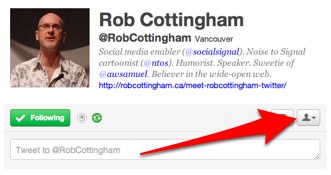
Today I noticed an irony on the SIM Centre website: our Twitter sidebar widget, which does a lovely job of displaying tweets from all those who are connected to the SIM Centre, wasn't showing tweets from the SIM Centre itself. I realized that was because our sidebar...
6 solutions to the sadness of social media
Is social media making us sad? On the UK's Channel 4 News website, Benjamin Cohen is concerned that social media is changing the nature of friendship, and has adjusted his use of social media in response: I’ve stopped sharing as much, full stop....I’m not suggesting...